Validated engineering campaign

Fine-to-coarse simulation mesh search with downstream validation.

Looptimum explored a bounded 216-point mesh-control space in 21 evaluations, then the selected coarse candidate was checked against a trusted fine reference in a separate solver pass.

Validated campaign results

72.9%

Fewer mesh cells

658,647 to 178,473

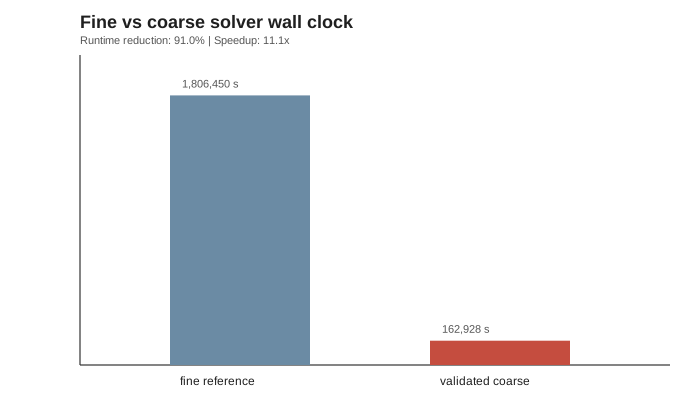
91.0%

Lower solver wall clock

1.806M s to 162,928 s

11.1x

Solver speedup

Validated coarse candidate

<1%

Outlet-flow drift

All major outlets

<0.5

MAP / PP drift (mmHg)

Aggregate pressure parity

Result boundary

An observed optimum accepted through domain-specific validation.

The selected coarse candidate materially reduced mesh size and solver wall clock while meeting the campaign's stated flow, pressure, and solver-completion checks. These results belong to the archived geometry, workflow, reference case, and acceptance thresholds; they are not a general performance guarantee or a claim of global optimality.

Campaign objective

Replace an impractical fine mesh without giving up trusted behavior.

The fine-refined starting point produced reliable pressure and flow results but required weeks of solver time. The campaign searched for a numerically stable coarse mesh that could preserve those behaviors while reducing the cost of repeated solves.

Evaluation boundary

The meshing and solver workflows stayed external.

Looptimum proposed bounded mesh-control configurations and recorded their outcomes. Existing meshing, checkMesh, and solver workflows performed the application-specific evaluation and downstream validation outside the controller.
Engineering campaign figures

Bar chart comparing solver wall clock for the fine reference and validated coarse mesh

Figure

Solver wall-clock comparison

The selected coarse case reduced solver wall clock by 91.0%.
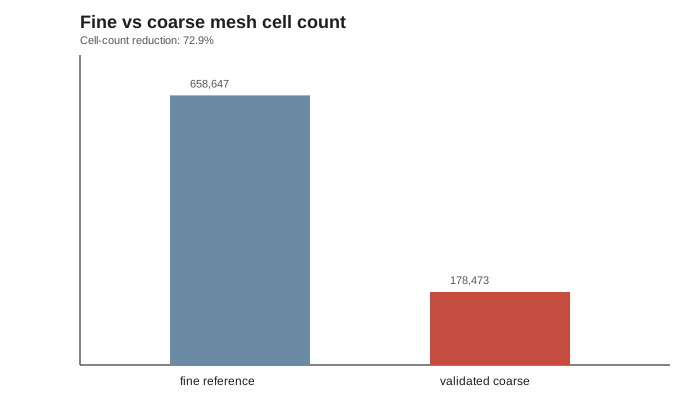
Bar chart comparing the cell counts of the fine reference and selected coarse mesh

Figure

Mesh cell-count comparison

The selected coarse mesh contained 72.9% fewer cells than the fine reference.
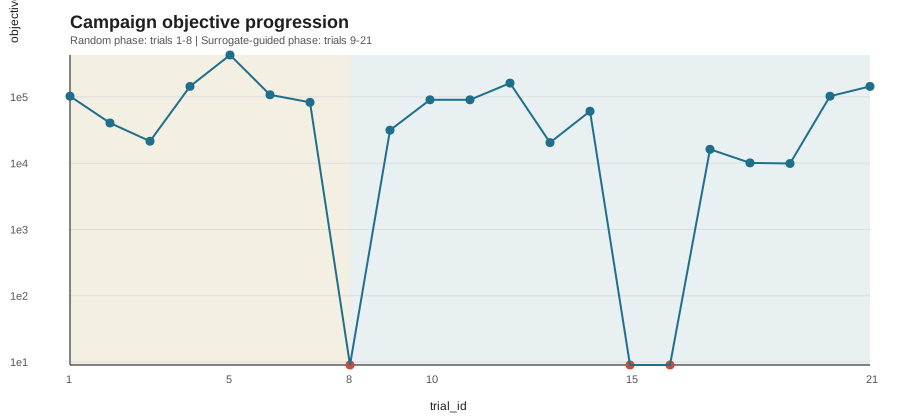
Line and point chart showing objective loss across the engineering campaign

Figure

Objective progression

The campaign explored fewer than 10% of the bounded search space and identified a repeatable low-loss basin.
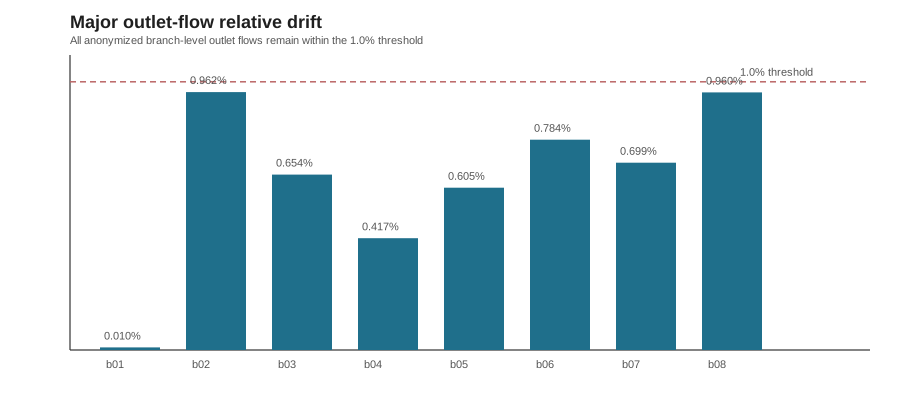
Chart showing outlet-flow drift for the selected coarse mesh against the fine reference

Figure

Outlet-flow validation

All major outlet flows remained within the stated 1% validation threshold.
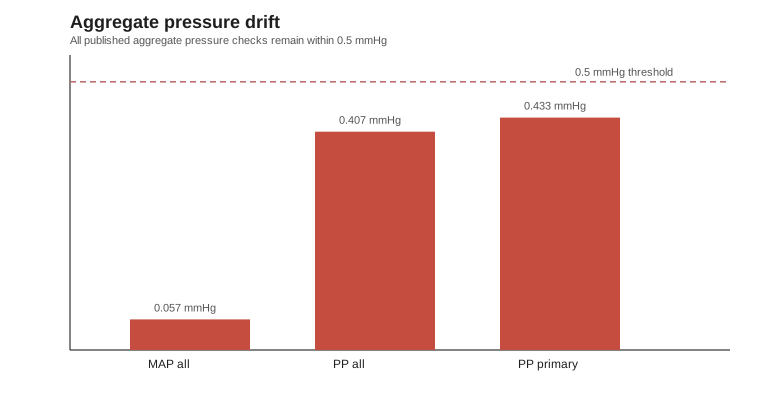
Chart showing aggregate pressure drift for the selected coarse mesh against the fine reference

Figure

Aggregate pressure validation

Aggregate MAP and pulse-pressure drift remained within the 0.5 mmHg acceptance band.

Campaign record

Bounded search with an auditable decision history.

  • 216-point bounded search space
  • 21 executed trials
  • 8 random starts, then 13 surrogate-guided suggestions
  • Archived objective loss for the selected candidate: 9.0
  • One failed checkMesh outcome preserved in the campaign record
  • Final acceptance based on solver and mesh-independence evidence

Validation thresholds

Acceptance required more than the optimization score.

  • All major outlet flows within 1%
  • Aggregate MAP within 0.5 mmHg
  • Aggregate PP within 0.5 mmHg
  • Solver reached 4.999946 s against a 5.0 s target

Limitations

What this campaign does not establish.

  • The selected candidate is an accepted observed result, not a proven global optimum.
  • The reported savings are relative to this campaign's fine reference and workflow.
  • Exploring fewer than 10% of this search space does not guarantee the same efficiency elsewhere.
  • Objective loss alone did not establish physical acceptability; a separate solver pass was required.
  • Transfer to another geometry, solver configuration, or acceptance regime requires new validation.

Continue

Bring a bounded, expensive evaluation loop.

We can assess whether a client-owned evaluator and a validation-aware campaign are a good fit for Looptimum.