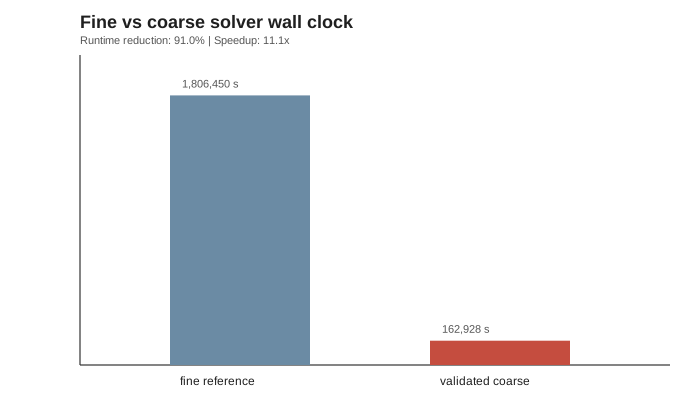
Validated engineering campaign
Fine-to-coarse simulation mesh search
A bounded engineering campaign paired its selected candidate with downstream solver and mesh-independence validation.
Read the case studyBlack-box optimization for expensive evaluations
Looptimum is a lightweight controller that uses previous results to select the next bounded trial, replacing broad sweeps and manual tuning with a sequential, resumable optimization loop.
How the loop runs
The controller maintains the optimization state and suggests what to try next. Your existing script, cluster, solver, experiment, or workflow executes the trial and returns a result or declared failure.
Looptimum uses the campaign's completed results to select the next bounded candidate instead of scheduling a broad sweep.
Your evaluator runs where it already lives: cluster jobs, scripts, CI runners, solver hosts, or lab workflows.
The result—or a declared failure—is recorded in local files so the campaign can resume after interruptions and preserve an auditable decision trail.
Validated engineering campaign
A bounded engineering campaign paired its selected candidate with downstream solver and mesh-independence validation.
Read the case study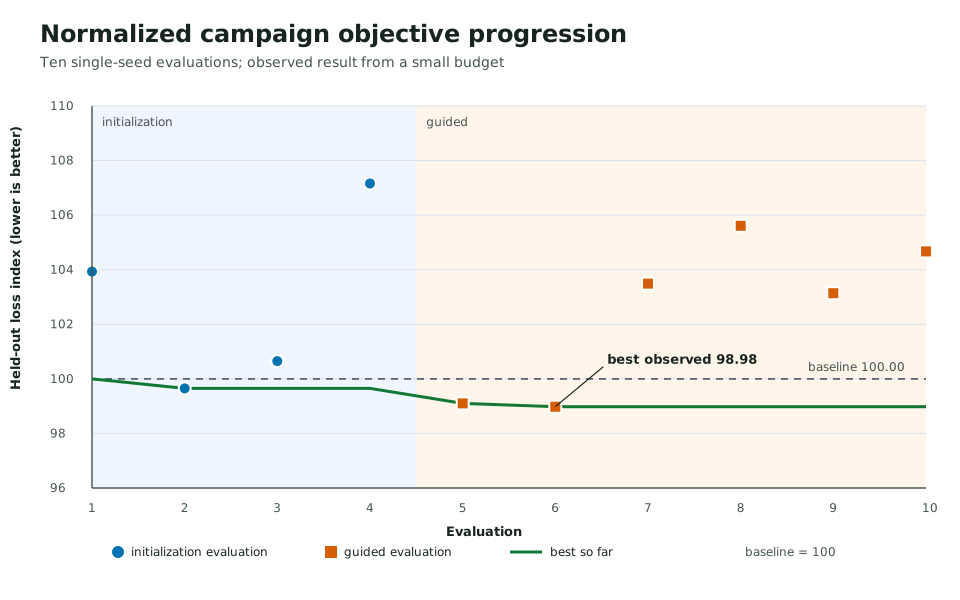
Anonymized ML campaign
Ten bounded evaluations tested four generic recipe controls while the training evaluator remained externally owned.
Read the case studyUse cases
The best early engagements have a real evaluation bottleneck, a bounded set of decision variables, and a team that can already run the underlying process inside its own environment.
Mesh controls, solver tolerances, calibration knobs, and workflow parameters where every run costs serious compute or analyst time.
Concurrency, retry policy, memory limits, thread counts, cache TTLs, and resource controls with measurable cost or latency impact.
Training recipe knobs, evaluation thresholds, batch sizes, and runtime controls when experiments are slow and failures are expensive.
Lab workflows, ETL processes, and production runbooks where throughput, quality, and cost need to be balanced under guardrails.
Earlier-stage work
The Looptimum Advanced Research Consortium works with ambitious, early technical projects where efficiency, optimization, or computational feasibility may shape the architecture and the path to implementation.
If you already have an expensive evaluator, core Looptimum may fit. If the system and its evidence pathway are still being designed, explore LARC.
Read about LARCContinue
Start with the cost of one evaluation, the knobs you can bound, and the result you need to improve.

Meet the team
Founder, Developer
David Y. is the founder and lead developer of Looptimum, where he works at the intersection of optimization, machine learning, scientific computing, and complex systems engineering. His technical work spans computational hemodynamics and medical-device research, physics- and data-informed modeling, Bayesian optimization, custom machine-learning pipelines, and applied language-model development. He has built and maintained research software for simulation, statistical analysis, model calibration, and experimental workflows, with a particular focus on problems where computational efficiency, model fidelity, and practical implementation are tightly coupled. Through Looptimum, he develops optimization-driven tools and research workflows intended to turn technically difficult, computationally constrained problems into tractable engineering and scientific systems.
View GitHub profile