Evidence

An acceptible optimum must survive validation, not just score improvement.

The example pairs a bounded snappyHexMesh campaign with a post-hoc solver pass against a fine reference case.

72.9%

Fewer mesh cells

658,647 to 178,473

91.0%

Lower solver wall clock

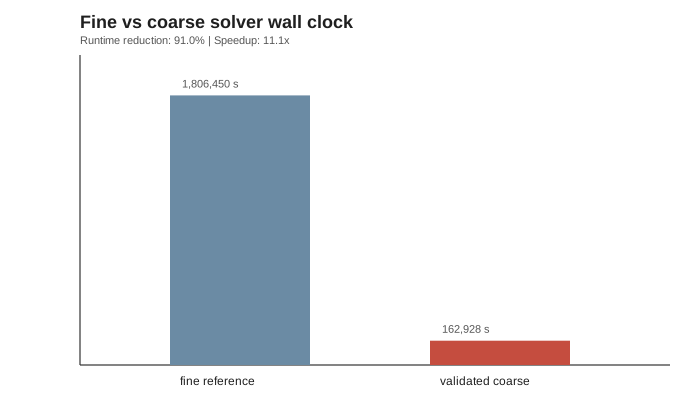
1.806M s to 162,928 s

11.1x

Solver speedup

Validated coarse candidate

<1%

Outlet-flow drift

All major outlets

<0.5

MAP / PP drift (mmHg)

Aggregate pressure parity

Campaign objectives

Start from a trusted fine mesh. Find a validated coarse mesh that is actually usable.

  • The starting point is a known-stable fine-refined mesh that delivers accurate pressure and flow results but takes weeks to solve.
  • That becomes untenable when the same geometry must be solved repeatedly under different boundary-condition settings.
  • The goal is a coarser mesh that maintains pressure and flow fidelity while materially reducing total cell count and solver time.
  • With snappyHexMesh, finding a numerically stable coarse mesh by hand can be difficult or effectively impossible because the parameter space is large and sensitive.
  • Looptimum makes that search intentional, data-driven, and auditable while pushing trial selection toward low-loss, high-reward tests.

Campaign summary

Validated fine-to-coarse mesh campaign with Looptimum

  • 216-point bounded search space
  • 21 executed trials
  • 8 random starts, then 13 surrogate-guided suggestions
  • Archived objective loss for the selected candidate: 9.0
  • One archived failed checkMesh check, documented rather than hidden
  • Accepted on solver stability and fine-vs-coarse mesh-independence evidence

Validation thresholds

Optimal mesh acceptance criteria

  • All major outlet flows within 1%
  • Aggregate MAP within 0.5 mmHg
  • Aggregate PP within 0.5 mmHg
  • Solver reached 4.999946 s against a 5.0 s target

Evidence

Solver wall-clock comparison

The selected coarse case reduced solver wall clock by 91.0%, which is the most direct operational proof for a client-facing pitch.

Bar chart showing a large runtime drop between the fine reference and the coarse validated mesh

Evidence

Mesh cell-count comparison

Cell-count reduction establishes that the solver gain came from a materially lighter mesh rather than a cosmetic parameter change.

Bar chart showing cell-count reduction from the fine reference mesh to the coarse validated mesh

Evidence

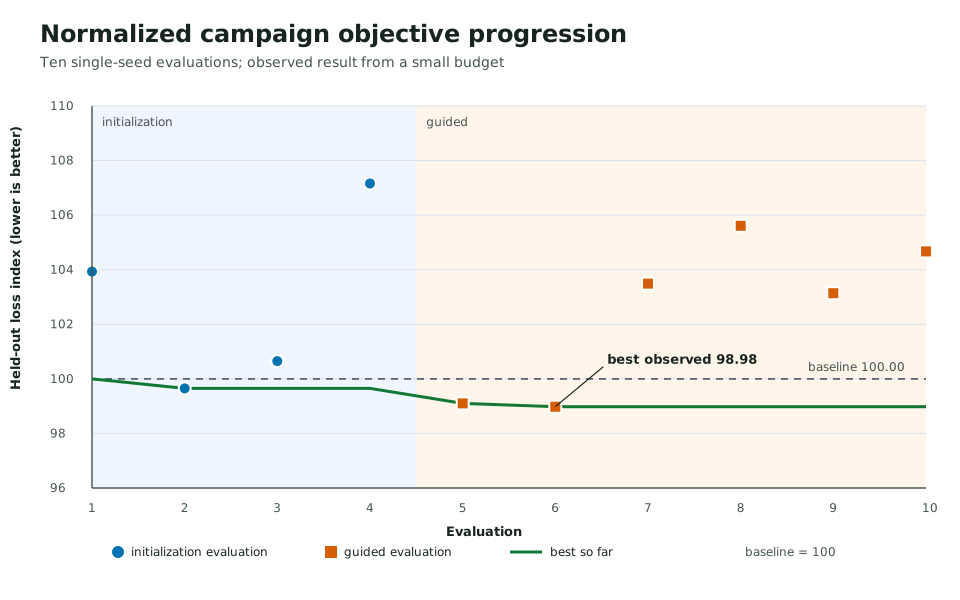
Objective progression

The campaign explored less than 10% of the bounded search space and still found a repeatable low-loss basin.

Line and point chart showing loss reduction over the campaign

Evidence

Validation drift

Downstream validation stayed inside the stated outlet-flow threshold.

Chart showing outlet-flow drift staying below the 1% threshold

Evidence

Aggregate pressure parity

Aggregate MAP and PP remained inside the 0.5 mmHg acceptance band, indicating mesh-independence of the results.

Chart showing aggregate pressure drift staying within the 0.5 mmHg threshold

Results

Exit criteria achieved with notable improvements.

  • 72.9% fewer mesh cells
  • 91.0% lower solver wall clock
  • 11.1x solver speedup
  • All major outlet flows within 1%
  • Aggregate MAP and PP within 0.5 mmHg

Next step

Explore Looptimum on GitHub or request a project assessment.

Review the validated example, inspect the supporting evidence, and decide whether the same approach fits your own expensive evaluation loop.